All posts by donna burke esgro

In Praise of Battered Books

IMG_8704

copyright©donnaesgro

*

“Do you know that books smell like nutmeg or some spice from a foreign land? I loved to smell them when I was a boy. Lord, there were a lot of lovely books once, before we let them go.”

Ray Bradbury – Fahrenheit 451

*

I remember my mother sitting on a blue wooden bus bench in Santa Monica, California, absorbed in a paperback detective novel. She was a displaced New Yorker, familiar with the ennui of bus, train, and subway stations.

As soon as I was old enough to read, she advised me, “Always carry a paperback book with you-that way you will never mind waiting.”

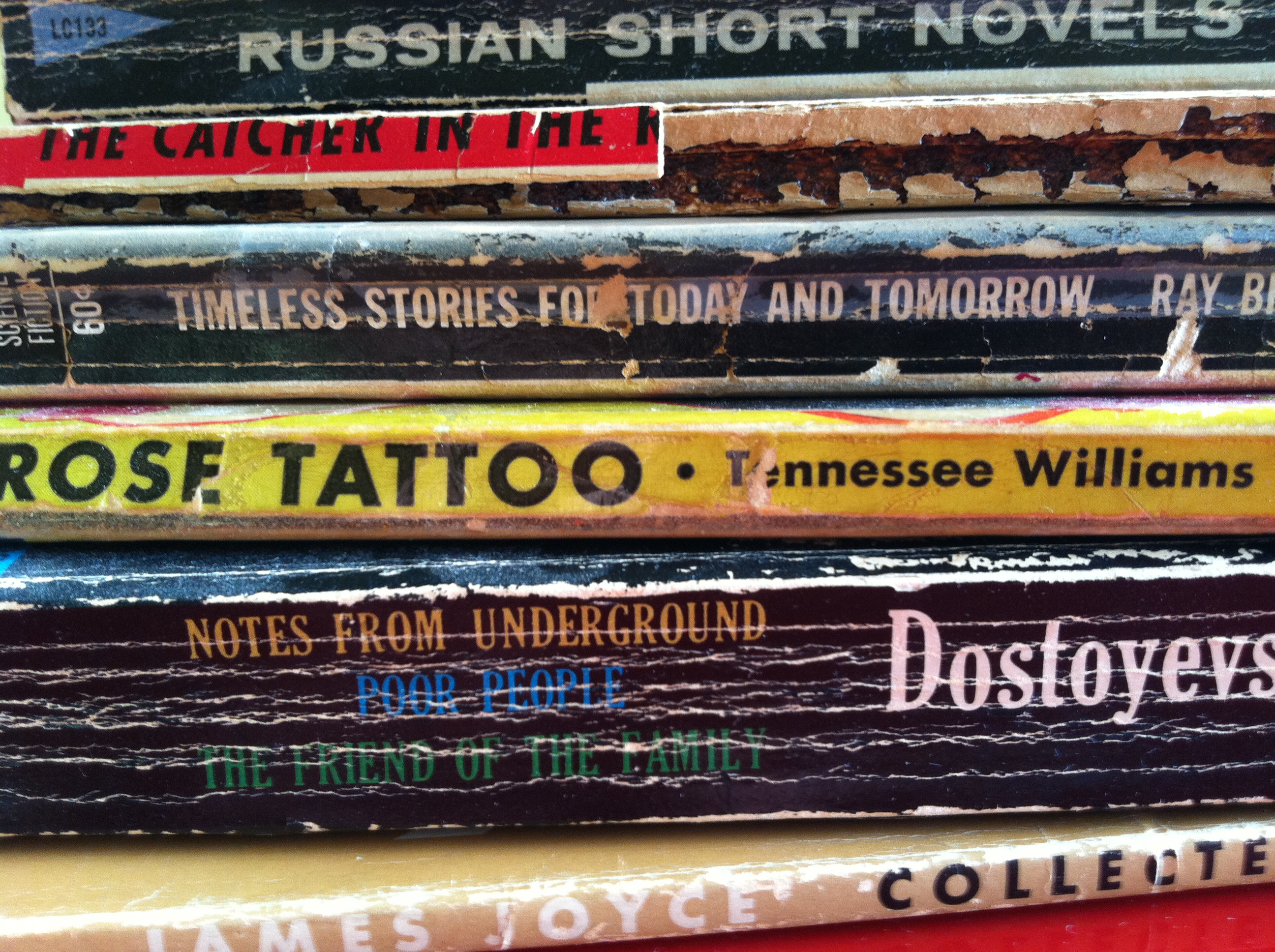
And that’s how it began – my collection of battered books. Library books stayed at home, but there was absolute freedom in a paperback, sand in-between the pages, blowing in the wind. It all began with a little girl in blue glitter glasses reading Nancy Drew on the school bus and The Secret Garden in the back seat of the car.  Then, my best friend in middle school introduced me to the dark, lovely, literary, wildness of Ray Bradbury. I’d spend the night at her house, the two of us reading Something Wicked This Way Comes, from one paperback book, under the covers, eating M & M’s, long into the night.

As a restless young teenager, I walked the tree lined streets of my neighborhood with Walden’s Pond in the back pocket of my jeans. Sitting under the fragrant Eucalyptus trees, I’d pretend I was alone in the woods.

And then there was the lanky intense boy, one impossible year older, who read Dostoyevsky aloud to me on my front porch steps until the houses around us turned into sharp silhouette and the porch lights blinked on. Our sweet sixteen love lasted one jasmine soaked summer, but he left me Fyodor, and a paper back The Brothers Karamazov whose cover has been taped back on a dozen times.

I was accompanied by Salinger, Ferlinghetti, and Hermann Hesse on my first plane trip to San Francisco. I was seventeen and free – drinking out of tiny cups at the Japanese Tea Garden in Golden Gate Park with my book propped on the table.

I have an old Art Deco style glass case protecting the first editions in my home. When I open the intricately carved doors the musty smell of old paper wafts and mesmerizes. But in my handbag, I have a revolving assortment of paperbacks, content to be jostled about, ignored for days, then read non-stop for hours-like old friends who can be silent together until it’s time to talk deeply.

I have a great reverence for books, and turn the pages carefully in my old and valuable ones, but paper back books get thrown into back packs, go with you on hikes, on camping trips, or barefoot to the beach on a sweltering summer day. They can be left out in the dew all night, and not lose their beauty.

Read them, share them, and when you are ready, leave them one by one  on scattered benches in memory of my mother.

Why Should You Read the Book Before You See the Movie?

IMG_1715

copyright©donnaesgro

*

Hans Christian Andersen’s Little Mermaid quests for an Immortal Soul

Disney’s mermaid, Ariel, quests for a Prince Charming.

My fourth grade Book Club recently finished reading James and the Giant Peach. Each meeting was spent reading a chapter or two out loud, taking turns being different characters, and talking about what the words made us think or feel. Raoul Dahl’s descriptive language made is easy to imagine both the scenes and the characters: “For suddenly, just behind him, James heard a rustling of leaves, and he turned around and saw an old man in a crazy dark-green suit emerging from the bushes. He was a very small old man, but he had a huge bald head and a face that was covered all over with bristly black whiskers.”

I was reading from an edition with the original illustrations by Nancy Ekholm Burkert, while the children’s books were more recent editions, illustrated by Quentin Blake. We used this difference to contrast and compare the illustrator’s interpretation of the story. Everyone noticed that my book’s drawings were eerie and mysterious, while theirs were humorous. This led to a discussion about Dahl’s style, how, indeed, his stories were both strangely frightening and oddly funny.

Each one of us imagines a different world when reading James and the Giant Peach, each envisions a different old man. But what if one sees the movie before reading the book? Whose vision would he see? Viewing a movie first limits the ability to imagine own’s one scenes and characters. It stifles the individual’s ability to conjure an alternate reality-one of the truly enchanting aspects of reading. “As with all great art, the fairy tale’s deepest meaning will be different for each person, and different for the same person at various moments in his life. The child will extract different meaning from the same fairy tale, depending on his interests and needs of the moment.” Bruno Bettelheim – The Uses of Enchantment

In the 1996 film adaptation of James and the Giant Peach, Aunt Spiker looks like Joanna Lumley, and Miss Spider is a heavily made up French vamp in a beret and high black leather boots. Not that these portrayals aren’t brilliant, but they are not one’s own. Our imaginations are limitless. Imagination, like dreaming, is a uniquely personal experience; movies, a group one. There is also a very good chance that once a child (or an adult) sees the movie version of a book she will lose interest in reading it. This is especially true of children who are struggling with reading, or teenagers who live in such a fast paced electronic whirlwind that they lose patience with the time it takes to read a novel, particularly a classic novel with somewhat arcane language. If the only experience one has with a particular book is through the movie version, he is missing out on a deeper, richer interpretation of the story. When a child reads a book before seeing a movie he understands the source of the story, makes the connection between written words and the images in the movie. The movie is not seen as an isolated experience. Having read the book allows the child to understand the movie in greater depth. There are many great authors (Pamela Travers, author of the Mary Poppins Series) who have been extremely disappointed with how their works were translated to film. Others, such as Raoul Dahl and Theodore Geisel had works sold posthumously to movie producers because the authors just didn’t believe that the experience that they wanted the reader to have could be translated well into film. Neither Victor Hugo (The Hunchback of Notre Dame), A.A.Milne (Winnie the Pooh), nor Lewis Carroll (Alice in Wonderland) lived long enough to comment on the animated version of their classic works. So we can only wonder…

Letter, written in 1957 from J.D. Salinger regarding movie rights to Catcher in the Rye:
blogSpan

I love good films and would want every child to see the classic 1939 production of The Wonderful Wizard of Oz. But read the book first. Let your child step into Dorothy’s slippers and walk the yellow brick road herself before the charming Judy Garland and the rest of her immensely talented companions, Bert Lahr, Jack Haley, and Ray Bolger, completely capture her imagination. When a child first reads The Wonderful Wizard of Oz, she will discover that L.Frank Baum wrote a series of Oz books – all quite magical and wild, and rarely read by children today. One good book leads to others.

With very young children there may be other reasons to read the book first and wait until they are older before they see the movie. Child experts have noted that separation anxiety is frequently used as an emotional hook in Disney films. And, although children’s imaginings, when reading or being read to, are profound, they do not normally traumatize as many a villain in Disney movies have.

Charming as Disney characters can be, it is important not to lose site of the fact that Disney is a multi-billion dollar industry, thanks to your children. Although there have been recent attempts to break the traditional Princess roles, generally female characters in Disney films give young girls an unrealistic, highly commercialized standard of beauty that reinforces extreme and one dimensional gender role stereotypes. When reading the original fairy tales, there is much more emphasis on the idea that beauty is used as a metaphor for goodness, and not for selling back- packs. There is no question that movies, even those made specifically for children, have become more violent, and more realistic in that violence. This, paired with the easy access to movies in the modern home through internet streaming, cable, etc., is cause for concern. Children today watch far more movies than previous generations. The fast paced editing, garish coloring, casual violence, and loud sound tracks stimulate children who often internalize the conflicting emotions that arise – feelings which, with many children, can cause restlessness, anxiety, and aggressive behavior. Books calm children down, develop their cognitive abilities, and help them feel in control of their emotions. Rather than desensitizing them to violence, books help develop empathy and compassion for others. Often, young children are media illiterate and believe that what they see in the movies is true. They are better able to understand the role that “pretend” plays when reading a book.

In my experience teaching, I am surprised to see how many children don’t realize that their favorite movies began with books, and that some of these stories are over 100 years old – that someone had to first imagine a story and then write it down before a movie could be made. Understanding such simple facts broadens historical perspectives and helps comprehension. I don’t want my young students to think that they know the story of Beauty and the Beast, The Little Mermaid, Winnie the Pooh, or Alice in Wonderland based on the popular animated versions. I want them to be explorers in the world of literature. I want them to realize the art, truth, and beauty of these original stories.

The key to captivating children on the sultry beauty of language is to start early. Make it a family rule that your child reads the book before he sees the movie. If he is too young to read, read to him. I am a great believer in parents continuing to read stories to children long after they can manage the reading themselves. It is a delightful shared practice that tells your child how much you value literature, and how important it is for you to share that appreciation with him. If you pick the right books, especially those that you loved as a child, you will not regret it. It is a wondrous thing to read great stories aloud.

Finally, reading, because it is active rather than passive, helps to develop logic and cognitive skills. It improves concentration, comprehension, vocabulary, and writing skills. Or, put in a more succinct way:

“If you want your children to be intelligent, read them fairy tales. If you want them to be more intelligent, read them more fairy tales.” Albert Einstein
Books vs. Bullies

kid dwg 2002 copy-2 3

copyright©donnaesgro

*

Walk as though you’ve been given one brown eye and one blue

Body & Soul…Charles Wright

***

Bullying is a complicated socio-psychological issue. Bullies have always been among us in one form or another, but with the advent of the internet and the unprecedented prevalence of teenage texting it has reached pandemic, twenty four hour a day, proportions. The heart breaking stories of teen suicides brought on by severe cyber bullying have shocked and wounded us all and served to create a keen cultural awareness of the seriousness of bullying. Many articles have been published on the subject, programs implemented in schools, and anti-bullying laws put in place. Yet, statistics show that these interventions have little effect on day to day bullying in the playgrounds and corridors of our schools.

If aggression is part of human nature, then so is empathy. Bullies are made, not born. Our society, as a whole, needs to take responsibility for having created a culture in which bullying exists in every middle and high school in the country. How do we reinforce the empathetic nature in our children and discourage the aggression in a milieu that justifies violence as entertainment, is fascinated by power, sees mean spiritedness as humor, and glorifies only a certain body type as attractive?

I believe that when home and preschool environments value, teach, and practice kindness a foundation that prevents bullying later in life can be built.

Normal behavior at the preschool level involves constant experimentation on how to get along with others. Although children have an innate desire to make friends they must learn how to do so. Anyone with a toddler knows that basic social skills, such as sharing or waiting for your turn do not come naturally or easily, yet, even very young children enjoy being around their peers and overflow with affection for others. Children learn by imitation, following the lead of parents, teachers, and older siblings. Modeling thoughtful words and actions is extremely important, but there is more-attention needs to be paid to raising a child with a strong sense of self worth. Bullies are able to hold power in an ambiance of hierarchy and fear. Feeling powerless themselves, they prey on those who they sense can be intimidated.

At the earliest stages of a child’s life, there should be a concerted effort to create an atmosphere of respect that values each and every living creature precisely for their unique qualities; an atmosphere that not only appreciates others but that also honors the self.

“Today you are you, that is truer than true. There is no one alive who is youer than you.” Dr. Seuss, Happy Birthday to You!

Books can be extremely helpful in fostering a climate that encourages reflection and instills empathy. Who doesn’t suffer with the ugly duckling or feel angry at the mean swans? In both fairy and modern tales the most important quality, and one not lost on the child, is character. There is a great power in language, and reading to your child is a wonderful way to fill their hearts with caring. There is no need to focus only on books that specifically address bullying (and there are many fine ones for all ages). Books that address diversity such as David McKee’s Elmer the Elephant, champion courage, like Watty Piper’s classic, The Little Engine That Could, or promote individuality as in Kevin Henkes’ Chrysanthemum, help children understand that being little does not mean being incapable and being different does not mean being an outcast. Books of this nature are helpful in beginning conversations that allow the child to examine and express feelings difficult to articulate.

Unconscionably, studies show that children with disabilities are two to three times more likely to be victims of chronic bullying directly related to their disability. (Marshal,Kendall, Banks, & Gover (Eds.) 2009). It is a short distance from being bullied to bullying one’s self: I’m ugly, I’m fat, I’m gross, I’m worthless..words that become a endless reel in the victim’s mind, leading to anxiety, anorexia, depression and other unbalanced emotional states. When parents and teachers cultivate an awareness of others, and introduce an early exposure to people of all colors, ideas, cultures, and disabilities, they are planting the seeds of empathy. While it may be difficult to expose a very young child to this broad family of man, books can take us all over the world, through time and space, and into the thoughts and feelings of a vast diversity of people.

30% of all school age children are either bullies or bullied while 70% look the other way. More than half of all bullying situations stop when a peer intervenes on behalf of the student being bullied. (Hawkins, Pepler, and Craig, 2001) The statistics speak for themselves. Bullying is a cultural phenomenon. There is tremendous strength in the 70%. Let’s raise our children to be courageous, to speak up for injustice. We may not be able to change the reality of bullying, but we can work, from the very beginning, to raise empathetic children, with a sense of individual pride and dignity who will use their 70% majority to speak up for what is right-beginning in the school corridors, and spreading from there out into the world.

Play Makes You Smart

article-2331639-1A066DEC000005DC-390_964x847

copyright©Bettmann/CORBIS

*

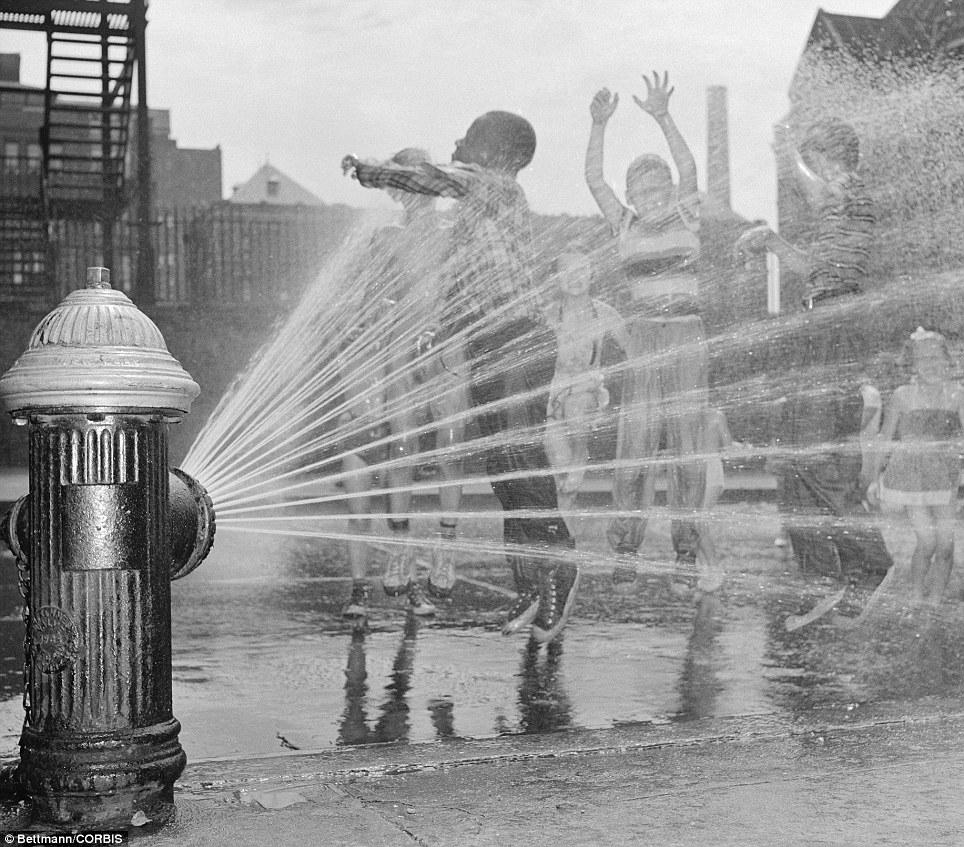
Play is vital in the acquisition of early literacy skills. At first babies play alone or with their immediate care giver, then side by side with peers (parallel play). At about the age of two and a half children begin to engage in imaginative play-they pretend, and when they pretend, they tell stories. Stories with plots, action, characters – liner stories with sequence. These stories present the child with a delicate balance of challenges both physically and mentally. In play, as in reading, children grapple with abstract ideas and differing points of view that allow a multitude of opportunities to learn.

The dragon climbs to the top of the highest mountain (the slide) and roars! We all run and the dragon chases us. He’s breathing fire! Where will we hide? In the castle (the tent), the dragon can’t get us there!

In play, children use multiple intelligences: visual, auditory, tactile, and kinesthetic, to experience the joy of storytelling. Play is so important in healthy child development that the United Nations High Commission for Human Rights has called it “The right of every child”.  Many children live tightly scheduled lives with very little time for child driven play, and when they do have free time, they often gravitate to passive entertainment such as television or computer/video games. In an effort to raise test scores, more and more schools have cut recess time to concentrate more on academics and formal physical education. Ironically, child development experts have found that reduced time for unstructured play may be a cause for restless anxiety in children that results in falling behind academically. In addition, neuroscientists now know that there are indisputable links between learning and physical activity- in order to be able to process new information the brain needs a balance of activity.  Think: All work and no play makes Jack a dull boy.

Play drives development. It is the hands on mechanism that children use to learn. In spontaneous play the child expresses what he is currently processing emotionally, intellectually, and physically. When choosing toys, look for interactive items that encourage creativity, such as blocks or dolls instead of passive toys that limit imagination. Advertisers are adept at creating a “cool factor” that encourages acquisition and competition around toys often linked to popular movies. Toys designed to be discarded when the next trend comes around. Free play with timeless toys such as chalk, bubbles, balls, and water itself, is refreshingly outside this foray of manipulative mass marketing and, because these types of toys require hands on exploration, help develop the cognitively flexible skills necessary for readiness to read.

In the attached Ted Talk, Dr. Stuart Brown, a pioneer in research on play and President of The National Institute For Play, speaks of the deep need for play, not only in humans, but in all species:

http://www.ted.com/talks/stuart_brown_says_play_is_more_than_fun_it_s_vital?language=en

In honoring the child’s freedom to play, we honor the “whole” child. It is impossible to know what challenges our children will face and what skills will be required of them in the future. But, emotional intelligence, tenacity, the ability to actively engage with others, to focus with keen attention, and to approach problems with creative solutions-skills honed in the playground- have always and will always be critically important.

ADD For ALL

IMG_3215 2

copyright©donnaesgro

*

“She’s flighty.” “He’s a dreamer.”

Should these children be diagnosed, labeled and medicated to make them conform? Are they abnormal, or just marching to the beat of a different drummer? Perhaps she’s flying somewhere and he’s dreaming of something far more interesting than the worksheet of the day. Are we creating standardized children to excel on our standardized tests? Our culture values achievers. Does enduring the weariness night after night that many children feel at finishing their homework count as an accomplishment? How does a child who continually fails, who is labeled as a troublemaker, who never gets the shiny sticker awards, or the stellar grades, develop belief in himself?

When, in the United States, approximately six and a half million of all school age children, one in five of every high school boy, and over ten thousand toddlers are taking powerful medications after being diagnosed with ADHD, it’s time to change the system, not the children. How do we teach both the child and the teacher the difference between bouts of creative distraction, when one thought is allowed to pinwheel into a beautiful display of many thoughts, and distractions that are indications that the child is not connecting, for any number of reasons, to the subject being taught?

It is not likely that the educational system will soon change to accommodate different types of learners, but individual teachers can. It is a teacher who often is the one to bring up the possibility of ADHD to the unsuspecting parent at the first parent/teacher conference. Although the diagnosis is purely subjective, there being no definitive test, either psychological or physical, for this condition, parents assume that the teacher must be right. Of course there are teachers who may be right, who with much serious forethought have made the difficult decision to approach this sensitive issue. But, more often than not, the teacher is wrong and herself a victim of the aggressive pharmaceutical marketing campaigns that are truly shameful considering the grave side effects and the unknown impact on brain chemistry that can afflict a child taking Ritalin, Adderall, Concerta, or any of the other potent psychotropic drugs. In the last 20 years the number of narcotized children skyrocketed from approximately six hundred thousand to over 3.5 million.

Psychologist Dr. Keith Conners, Professor Emeritus at Duke University, who was one of the first researches to bring ADHD to the public’s attention as a neurobiological disorder, states in a 2013 NY Times article, “The numbers make it look like an epidemic. Well, it’s not. It’s preposterous. This is a concoction to justify the giving out of medication at unprecedented and unjustifiable levels.” In the same article Roger Griggs, the pharmaceutical executive and entrepreneur who coined the term “Adderall” after his Orwellian idea of combining “A.D.D.” and “for all”, calls these drugs, “nuclear bombs that should be prescribed only in extreme circumstances.”

Teachers, as first responders, must begin to see that celebrating diversity in the classroom means more than creating an environment that respects those of all cultures and colors.   It means creating an equal opportunity classroom in which differences of all kinds are not labeled as deficits. Mastery of a subject often requires perseverance and repetition, but must it appear to the child as boring and without purpose? Most children, even those with diagnoses of ADHD, are able to concentrate with surprising tenacity if a subject interests them. Watch a child build a tower over and over in order to get it to balance, or fathom out a complicated puzzle. What motivates a child to work at these high levels of concentration? This is the subject that we should be exploring, and that all teachers should be striving to understand. How can we spark curiosity and create stimulating lessons that inspire creative and attentive students? Has our society gone so far wrong as to believe that a child not sitting quietly over schoolwork is a deviant who must be drugged into submission? It is time to stop ostracizing the atypical and eradicate the illusion that our childrens’ learning problems can be alleviated with meds. Instead, let parents and teachers unite to do the hard work of examining our current educational system and find solutions that do not label our children as the problem.

Learning to Listen

IMG_8190

copyright©donnaesgro

*

A child must learn to listen before he can listen to learn. Experts agree that the conditions which most affect  literacy take place in the home, long before a child enters school. Children listen, understand, and speak before they read, write, and spell. Without the former, the latter is impossible. It follows that the more developed a very young child’s language skills, the easier time he will have learning the academics of literacy. Reading to your child from the very beginning will help develop listening skills that are invaluable later in life. At first your active baby won’t have the attention span to allow you to read all the words of a book to her, but just sitting together enjoying books, talking about the illustrations, is enough to start. As time goes by, a young child who has access to a bookshelf will soon be seeking out books and sitting quietly pretending to read. This activity is not, simply, adorable. For a child, the act of pretending is a major step in learning a new skill.

In order to help a child learn to listen, keep the home environment as free of unnecessary distraction as possible. Turn off the background noise. This simple act will help to create a more peaceful atmosphere conducive to contemplation…and to reading. Music is not usually a distraction, but the news and commercials that accompany radio and television certainly are. Children are sensitive and their hearing is acute, try to shield them from the constant advertising and, more importantly, the disturbing violent events that are, sadly, so often in the news.

Another aspect in teaching children to learn to listen is to listen to them! The respect that you show when you pay careful attention to a child’s stories and questions teaches him the importance of listening. Ask interactive, open-ended questions that offer the child not only an opportunity to express himself but to develop cognitive skills. Avoid “baby talk” or talking down to a child. Children love “big” words; adults often underestimate their insatiable curiosity and innate ability to learn them. Books add a multitude of new words not used in daily life that enrich and enlarge your child’s vocabulary exponentially. The art of thoughtful listening is fast becoming obsolete. Help your child become attentive in a culture rife with sound bite  and the abbreviated language of texting. It is only in listening closely that we truly learn.

*

“The word ‘listen’ contains the same letters as the word ‘silent’.”  -Alfred Brendel, composer

The Power of Poetry

IMG_8030

copyright©donnaesgro

*

Poetry is often looked upon as irrelevant, a part of another era, when people had more leisure time, less distractions; when conversation was an art, and life wasn’t so frenetic. Yet, it is well documented by linguists that children who have early exposure to poetic verse and the phonemic and syllabic sensitivity it brings, have an easier time recognizing individual sounds and learning to read.

Poetry is the heartbeat of literature. Begin a rhyme in a room full of children and watch what happens…a sudden attentive stillness. Even babies, who can’t yet understand the meaning of the words, are entranced by the patterns, repetitions, and rhythms:

I am Sam

Sam I am

That Sam-I-am That Sam-I-am!

I do not like that Sam-I-am

Do you like 
green eggs and ham?

I do not like them, Sam-I-am.

I do not like 
green eggs and ham.

Dr. Seuss – Green Eggs and Ham

Rhyme draws attention to the ending sounds of individual words – alliteration to the beginning. The musical language of poetry rings and reverberates, creating in the child a fundamental joy in literature.

But should the reading of poetry end with nursery rhymes? The emotions that poetry evokes are universal. As children grow older, the reading and writing of poetry can help them to cope with vulnerable truths that are too fragile to share in other ways…love, pain, death, transcendence…feelings not likely to be discussed on social media.

Reading aloud one’s own poetry creates a forum for individual expression that inspires confidence and pride. To communicate profound feelings and see that others share them is a transporting experience. In a school system that stresses the head – test taking, memorization, grades, and competition – poetry celebrates the heart. In this increasingly homogenized culture, poetry’s power lies in its originality-whether wild with rage as in Allen Ginsberg’s Howl, or soft with the tenderness of e.e.cummings’ somewhere i have never travelled, gladly beyond, poetry connects us intimately and immediately to our deepest feelings.

The language of poetry encourages inventiveness with words. Hope is “the thing with feathers” (Emily Dickenson). Eyes are “the window to the soul”(Shakespeare). Poetry conjures images that broaden and enlighten the mind. Metaphor and simile invite the reader to look at life in different ways, using unexpected correlations that inspire creative thinking:

The fog comes

on little cat feet

It sits looking

over harbor and city

on silent haunches

and then moves on

Carl Sandburg – Fog

From the rocking rhythm of early lullabies to the healing strength of dirges, the simple truths of poetry cross all cultures, all boundaries. Introduce poetry early to share the wonder of words with your child, but don’t lose track of how poetry’s elegant, eloquent elucidation can inspire us throughout our life

Literacy – How it Begins

IMG_6165

copyright©donnaesgro

*

“The invariable mark of wisdom is to see the miraculous in the common.”

― Ralph Waldo Emerson

Oral language is the foundation of literacy. Within a few short months an infant’s cries become babbles, then, suddenly, talking! Soon, the young child understands the meaning of thousands of words. The acquisition of language happens at a remarkable speed. Every time a child learns something new, it becomes a part of his knowledge base. Since words are simply articulations of concepts and feelings, it is evident that a child’s vocabulary should be measured not by how many words he knows, but by what he knows about each word.

The more ideas that the child is exposed to, the deeper her understanding of certain terms: A child whose favorite book is Goodnight Moon understands the conception of the moon in a more visceral way once she has seen a bright full moonrise, or watched the moon disappear behind a cloud lined with silver. Thereafter, whenever the book is read to her, these images flood her mind allowing a richer appreciation of both the word moon and the familiar bedtime story.

One of the most giving words in the English language is the word, “Look!” When you invite a child to look, you give him the gift of your time, attention, and awareness. You joyfully invite him to join in a shared experience and with this simple word illustrate how communication bonds us. “Look! A dragonfly!” Fills the child’s mind with dragons, butterflies, fairies… “Can it breathe fire?” I have been asked. These opportunities to enlarge your child’s perspective happen daily, and books are a wonderful way to extend this rapid accumulation of knowledge. While the opportunity to see a rainbow doesn’t happen everyday, books, both fiction and non-fiction, can share the beautiful imagery of a rainbow with your child, reinforcing such basics as color recognition, but more importantly, encouraging him to see the wonder and glory of the natural world…and to look for rainbows everywhere.

Children are born scientists – curious and eager to explore. Knowledge is not a mere collection of facts, it is alive, pulsing-a process of discovery. Books provide an access to worlds that we cannot, otherwise, enter. From the bioluminescent depths of the sea to the mystical outer edges of the known universe, books satisfy the need and the love for communication that begins with the infant’s first cries.

Why Doing Absolutely Nothing is Important

IMG_1634

copyright©donnaesgro

*

“Not all those who wander are lost.”  J.R.R. Tolkien

The modern world is a hectic one. Between school, sports, dance, music lessons, karate class, and other extra-curricular activities that fill our children’s days, there is precious little time for them to be alone with their thoughts. To be alone with one’s thoughts is to let the mind wander…to imagine. When the brain is free of distractions thoughts become reflective, and unexpected connections are made that expand consciousness.

Daydreaming enables us to revisit our memories. Allowing time to process these intricate emotions leads to deeper understanding of ourselves and others. When children are given the time to ponder they begin to take leaps from what they know to what they don’t know. Often, these original ideas are sweet, innocent, or funny…but they are, unmistakably, inventive, and show the developing mind at work.

When a child daydreams, no one can intrude on his fanciful imaginings. He is free to explore, to make unique, whimsical associations that are the seeds of creative thinking. We live in a culture that values productivity, but, ironically, frowns upon the very dreamers who are the gateways to inspiration and invention. Einstein said, “The intuitive mind is a sacred gift; the rational mind is a faithful servant. We have a society that honors the servant and has forgotten the gift.”

It is not only composers or poets who benefit from daydreaming, but scientists, mathematicians, and engineers as well. MRI research has revealed that, during a daydream, areas in the brain associated with complex problem solving are activated. Scientists now believe that daydreaming is as important as the dreaming we do at night – a time when the brain works hard to coalesce and consolidate learning. Neuroscientist and human development psychologist, Mary Helen Immordino-Yang, in an article in the journal Perspectives on Psychological Science, states that daydreaming is vital to learning, ultimately strengthening cognitive abilities such as reading comprehension:

Daydreams can reveal truths that are not visible in the too bright light of everyday activities. Like a candle, or a star, they can help to lead us in the right direction. Let daydreams inspire your children. In a world that shouts for their attention, encourage and respect these quiet, thoughtful moments. Let’s teach our children to value the beauty of silence and their own fantastical inner worlds.

Is an E-Book as Good for Your Child as a Traditional Book?

Mother and Child Reading Frederick Warren Freer 1849-1908
Mother and Child Reading
Frederick Warren Freer
1849-1908

*

There are many delightful depictions of stories available electronically.But are they as worthwhile to your child as reading a traditional book? Childhood Development experts have not yet determined the answer to this question due to the fact that e-books have not been around long enough to collect the data necessary to come to a decision. The topic is of high interest to educators worldwide, and numerous studies have been conducted.

At best, reading to a child is not a static activity. Children feel warm, secure, and loved sitting next to a parent or grandparent with a book. They receive a not so subliminal message that books are valuable, and that so are they. This feeling can last a lifetime, conjuring pleasant and joyful memories associated with books.

Even very young children learn quickly how a book works; front to back, page to page, top to bottom. They see as they follow the story, that those strange shapes called letters have something to do with spoken words. More importantly, they are not distracted by the bells and whistles designed to enhance the e-book experience, they are free to comment, to ask questions, to ponder new ideas and make connections. The adult reader can extend these connections and make them personal. “Remember when we went to the zoo like Curious George?” “Was the lion scary?” “How many monkeys are in the tree?” “What colors are the flowers?” There are countless ways to extend even the simplest of books.

Only the parent knows the child’s most passionate interests. If your child is fascinated by anything from the solar system to insects, you can use this knowledge to make the book that you are reading a more interesting and individual experience….an illustration of a butterfly can lead to a conversation about metamorphosis, and, more importantly, it can lead you outside…to look for butterflies, to talk about what butterflies like…”Do they like snow or sunshine?” “Do they like gardens or city streets?” “Do you think that they would like to be caught and put in a box?” “Why?” Fiction leads naturally to non-fiction. There are a multitude of beautifully photographed scientific books for children. I like the ACORN series, published by Capstone Global Library, because it works equally well for toddlers as early readers.

E-books have their place, but use them sparingly. I see so many children sitting in shopping carts or at restaurants with their brightly colored devices. Perhaps these children are mostly watching high quality applications. But, they are missing their community – the myriad opportunities for language that present themselves outside of the home, starting with, simply, conversation.

Reading is not only about being entertained. A child can learn much about nutrition from seeing you read the ingredients of a cereal box. He can learn about choices, and how you used reading to make them. Most importantly, your child is present in the real world rather than a virtual one, absorbing, as children so readily do, the connections between the words they see everywhere, from street signs to menus, and how they are used to communicate important information.

*

“I immediately felt a sense of nostalgia that I haven’t felt in a long time. The scent of physical books—the paper, the ink, the glue—can conjure up memories of a summer day spent reading on a beach, a fall afternoon in a coffee shop, or an overstuffed chair by a fireplace as rain patters on a windowsill.”

New York Times Tech Blogger – Nick Bilton-on wandering into a West Village bookstore.