Tag Archives: children

Teach Dialogue, Not Debate

Most high schools have a debate team. I’m not against competition in sports, there’d be no game if no one won and no one lost. But, I believe that the object of a debate team has been modeled on the objective of competitive sport. That is, to present your side forcefully enough, without nuance, to overcome your opponent.  Debate, then, is about being right. It is about being staunch and unable to be swayed in your fixed opinion. It is about being the winner.

Dialogue is listening thoughtfully, with an open mind. Open enough to hear another’s ideas. Open enough to possibly even rethink your opinion. Debate, by its very nature, leads to rift, while dialogue is an attempt to bring people closer together. In dialogue, we listen to understand, not to reply.

In a political debate, one would not expect one’s opponent to say,

“You’ve got a good point there.”

Whether or not you actually think your opponent is wrong, you must make the voting public believe that your opponent is an imbecile.

Debate is a verbal sparring, dialogue a verbal sharing. In classrooms all over the country, students in debate classes are asked to either choose, or are given, a side to defend. Their assignment is to quash the other team, whether they throughly believe their argument or not. Good practice for being in a political race, but not much else.

In a world that is ever increasingly polarized, debate polarizes. I want to live in a world of dialogue, in which people share ideas respectfully. I think most people want the same.  I believe that listening is a skill as well as an intention and that it can be taught in school, the earlier the better. 

Debate class teaches the student to shut down ideas from the other side. Let’s teach our children to be interested in exploring differences of opinion and to search for deeper understanding of each other’s points of view. Let’s show them the possibility of being challenged and inspired by new ideas that may contradict their own.

Social media is rife with alienating sound bites, a virtual debate team. What side are YOU on? If you are on the wrong side (aka the other side), you are a fool. There is no holding back what media has increasingly become, but in classrooms what we desperately need to encourage is patient listening, open mindedness, collaboration, and heartfelt communication. For it is only through communication that we build a community. 

If developing an open mind can be taught, so can close mindedness. The smugness of winning a debate is a cold victory. Most issues are complicated, many layered affairs. Let’s learn to hear, instead of to silence. To assent rather than to insist. Even if we disagree, we can strive to respect an opposing opinion. There may be glimmers of light within it that we are not privy to understanding. 

The future holds an abundance of complications for the students of today. To solve them will take global outreach, an ability to learn from one another and to compromise. Words have energy and power. How are we going to use their power? 

Thank you for listening.

***

“The best way to solve problems and to fight against war is through dialogue”

Malala Yousafzai 

Continue reading Teach Dialogue, Not Debate

Testing & Grades Are Obsolete

“One looks back with gratitude to those teachers who touched our human feelings. The curriculum is so much necessary raw material, but warmth is the vital element for the soul of the child.”

– Carl Jung

This morning I saw an ad for an app called Cograder. In the advertisement, a teacher spoke directly to his colleagues, “I teach high school English in Colorado”… He complains about having no time to do anything personal because grading takes so long-until he discovered Cograder, his A.I. assistant. Rather than teachers using artificial intelligence to help them grade, further separating the relationship between teachers and students, I propose a completely different solution: Eliminate tests and grades.

For an educator to suggest doing away with tests and grades is tantamount to blasphemy. But I believe that it is vital at this juncture in time when the uses of artificial intelligence are increasing on every front, to take a very close look at how we teach now and what the expectations are for students to come. 

The current concept of how schools should be was devised during the Industrial Revolution. We are currently in the midst of a Technical Revolution. Just as at the beginning of the Industrial Revolution there was no way to conceive of what the future would bring, in a rapidly evolving technology explosion, it is equally, if not more, impossible to predict our future. However, there are some things that we do know, some things that do fit a current and future world’s needs.  As the modern world becomes more and more divided into us and them, there is a desperate need now for building relationships, social skills, critical thinking, and empathy. 

A.I is here, it will evolve as it will, and let’s hope it’s for the best, but more than ever in an increasingly technical world, teachers’ relationships with students need to be built on compassion and understanding of each and every student as a unique individual.

When I say that our schools would work much better if we did away with testing and grading, I do not mean to suggest that we lower teaching standards, quite the contrary.  What I mean is that we must offer an environment that actively encourages learning, an environment that supports the innate yearning to grow, to lean toward truth and understanding.

Testing, grades, awards for high achievers, etc, are designed to promote competition rather than excellence, orchestrated to encourage children not to make mistakes, to be ashamed of mistakes, and to avoid them at all costs. Yet just about every professional in the field of education agrees that thinking of mistakes as the perimeter of a students’ mastery of a concept, and using that benchmark to create a better path to increased understanding, is the very best way to learn.

An atmosphere of discouraging mistakes creates a class room of children who inhibit their creativity out of fear of being thought foolish. Essentially, students silence themselves. They do not feel free to follow the rabbit trails of connections that lead to true perception. Comprehension of new concepts is a process that involves curiosity, creativity, and an open mind. It takes place in an environment of trust. Mistakes in a classroom should be  seen as opportunities to learn, and children should be encouraged for thinking outside the standardized boundaries.

Testing is too often a stressful experience that leads not to true or lasting understanding, but short term memory, all night cramming, and sometimes, cheating. Cheating (which, ironically, may entail a student using A.I.) may seem a viable alternative to failing if mistakes bring your grade down, which could affect your final GPA, which could affect your admittance to a prestigious university, which could affect your ability to get a decent job, which could affect your entire life…ad nauseam. Even if these strictures once were true, technology is changing our lives so rapidly that they can no longer be true, as we have no idea what the future will require.

Rather than doing things as they have always been done, let’s ask the question: What do we want to achieve through education? Are we succeeding in these goals by training students to test well, at the expense of teaching them to think?

At the risk of sounding utopian, try to imagine a school in which a child is truly respected. Although we cannot know what the future holds, one thing we do know is that our children are the future. Let’s stop expecting them to go into the factory of our current education system and come out a fully formed human ready to follow all the rules. Instead, let’s encourage them to wonder, to explore, to be curious and caring individuals. Let’s teach the whole child, and this means truly seeing the individual student, being sensitive to the nuance of how each student expresses herself. This cannot be accomplished by feeding a child’s responses into a virtual assistant without capability of emotion or nuance.

What is needed now, what is vital,  are teachers who are more human, not less.

When AI tears up at hearing an old song, knows the heart ache of seeing children suffer in senseless wars, stares in wonder at the night sky, falls down on its knees awestruck by the splendor of it all, the magnificence, the marvel, and the miracle of this beautiful blue spinning planet, when this happens, I will consider changing my opinion. 

“When I say it’s you I like, I’m talking about that part of you that knows that life is far more than anything you can ever see or hear or touch. That deep part of you that allows you to stand for those things without which humankind cannot survive. Love that conquers hate, peace that rises triumphant over war, and justice that proves more powerful than greed.” 
-Mr. Rogers

Reading Comprehension Affects All Learning

©donnaesgro

So often “reading comprehension” is  placed in a separate academic box, apart from social studies, science, and especially, mathematics. Does being adept at reading or good at math just come naturally?  Studies on the theory of being left or right brained are now thought to be unscientific.

Whatever the truth of genetic predispositions may be, I believe that we are asking the wrong question. How we learn is a complicated issue. 

One thing, however, is for certain. Reading well is critical to comprehension in all subjects, for every subject tells a story. 

Being able to understand math directions alone can make a big difference in a child’s self confidence and therefore success. I have taught many children who don’t read directions before completing a worksheet or taking a test.

These children, inevitably, find reading difficult and, rather than stumble over words they can’t even pronounce and are not absolutely sure of (equation, difference, ascending order, digit, ordinal number, denominator, expression, addend, dividend, divisor, equivalent fraction, common multiple, etc.), would rather plunge in and hope for the best.

In their early years, these same children look at the numbers in a word problem, and take a guess on whether to add or subtract. Later, when problems involve two or three steps, they are at a loss if unable to comprehend the story of the word problem itself. They will get a lower grade in math, if this is the case, but does it mean they don’t understand the math?

I admit I am a romantic when it comes to reading. Reading takes you to fairylands, under the sea, to the moon, to the past and to the future, it builds understanding of others, which leads to caring about characters and growing the mighty roots of empathy.  But reading is also 100% practical. It points us in the right direction, it teaches us how to assemble a shelf from IKEA (maybe), it helps us understand how to make up our own minds about what to believe and what not to believe-because in the written word we search for the truth, and, if we read deeply enough we can read between the lines, consider the source, and analyze and support the ideas that will lead us all to a better future. 

“Education is not the learning of facts, but the training of the mind to think.” Albert Einstein

The Lost Art of Nature Journaling

“Our society is much more interested in information than in wonder, in noise, rather than silence…And I feel that we need a lot more wonder and a lot more silence in our lives.” Mr. Fred Rogers

Nature Journaling, a popular pastime in the late 1800’s, has, like long walks, poetry, deep conversation, and, for children, playing outside from dawn to dusk, become a quaint thing of the past. Yet, nature journaling has a quiet power that is invaluable in our noisy world.

At the beginning of the Covid related lockdown while many people stayed inside with their computers, wildlife was returning to its long abandoned paths. Dolphins were seen playing in the Venice Canals of Italy, elephants wandered African freeways, and I, here in Southern California, watched a large mountain lion glide through my yard.

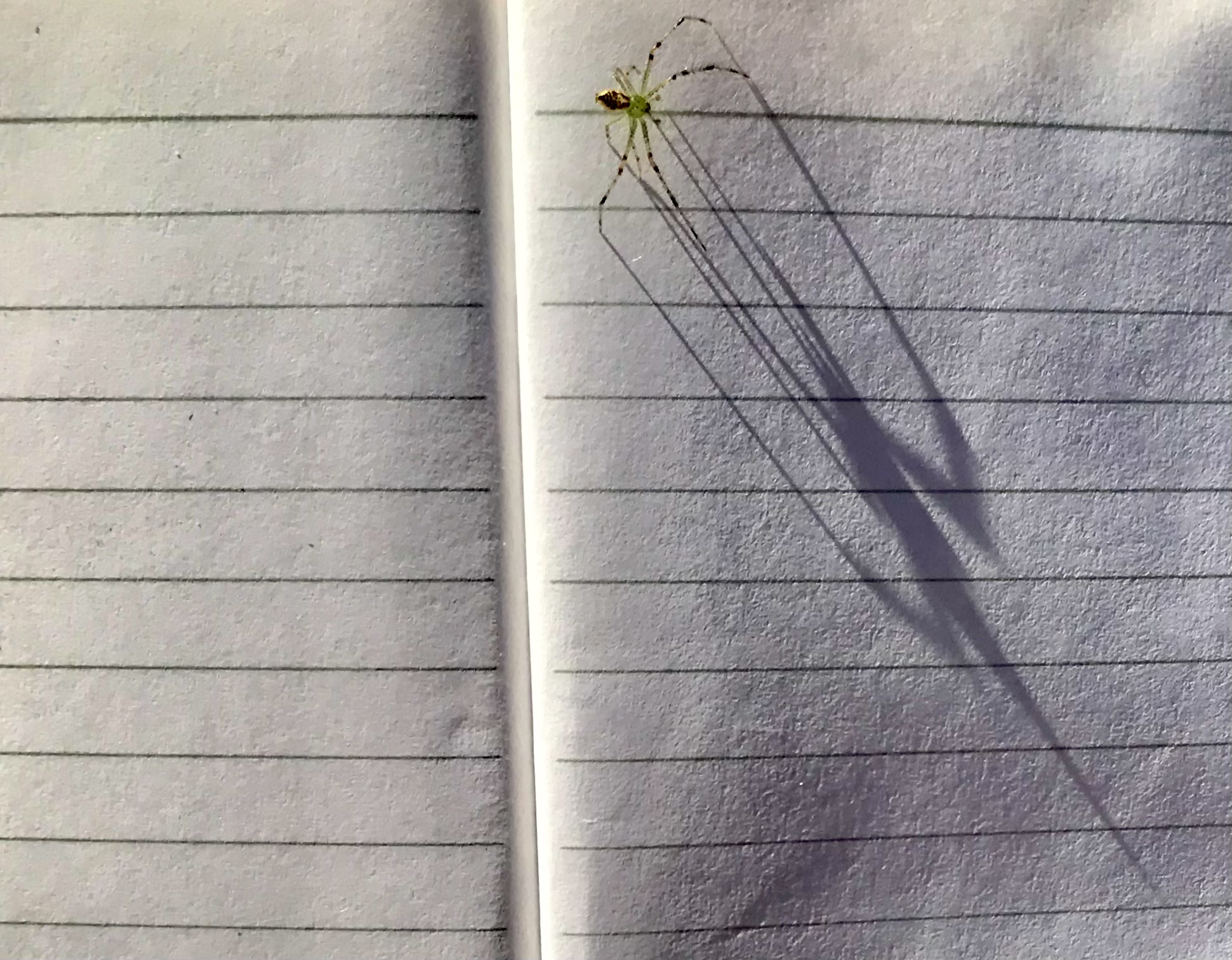
Nature Journaling needn’t be so dramatic. You don’t need to observe a hundred year old oak tree. A stalwart weed growing out of crack in a driveway can be as much a subject of wonder as any other.  Bees, crickets, ants, moths, snails, spiders, lizards, and dozens of birds busy themselves in their buzzing worlds, so mysterious to we humans. And yet, within all the mystery, do we not see ourselves in each and every living thing? Our bustling traffic, our structures, our language, our need for water, food, rest, and a flock of our own? The essential joy and truth revealed to us through the silent attention necessary to nature journaling is this…we are all intrinsically and beautifully connected. 

In the next few weeks try concentrating on becoming an observant naturalist. Pause and look at the world with respectful attention, all the while creating a journal that will be unique to you.

You will not need much…an inexpensive notebook to start. The best ones for nature journaling are spiral form so that the book can stay open in your lap or on the table. You want something that won’t be cumbersome to take with you on a walk. Find the size that you like, perhaps something that will fit in your everyday handbag. I work with 8 1/4” x 6 7/8” spiral books as a rule. A lined journal can work, if you tend to get wordy, but an unlined one is more traditional. Also put together a small pouch with a pencil or pen and several colored pencils, or watercolors.

Your journal will quickly become an extension of who you are. What is it, out of the proverbial “thousand things” that you observe? Why? In addition to your sketch, time, date, place, and weather, you may want to include a childhood memory, a poem that you love, even a dream, but all that a nature journal really needs is observations. So often people say that they can’t draw. Don’t let this concern you. My experience is that when you look at something carefully, you will surprise yourself at how well you draw. In the end, it is not about the photographic likeness, or the scientific name that the naturalists is after. It is about the reverence that comes upon you as your hand and heart connect when you try to draw the details of a spider web, a tiny flower, or a feather.

There is always something to observe when you begin to look with intention. And, when children see us journaling, they want to do it, too, guaranteed. Be ready with a notebook and box of crayons for them. For it is by modeling that we teach. It is by sitting quietly that we show our children, who, through no fault of their own, were born into an ever increasing fast paced technical world, how to appreciate the sun on their skin, the silhouette of a bird against a deep blue sky, and the soft grace of a butterfly.

In Support of Writing Your Own Spelling Words

 “If they give you ruled paper, write the other way.” 

Spanish poet Juan Ramon Jimenez 1881-1958

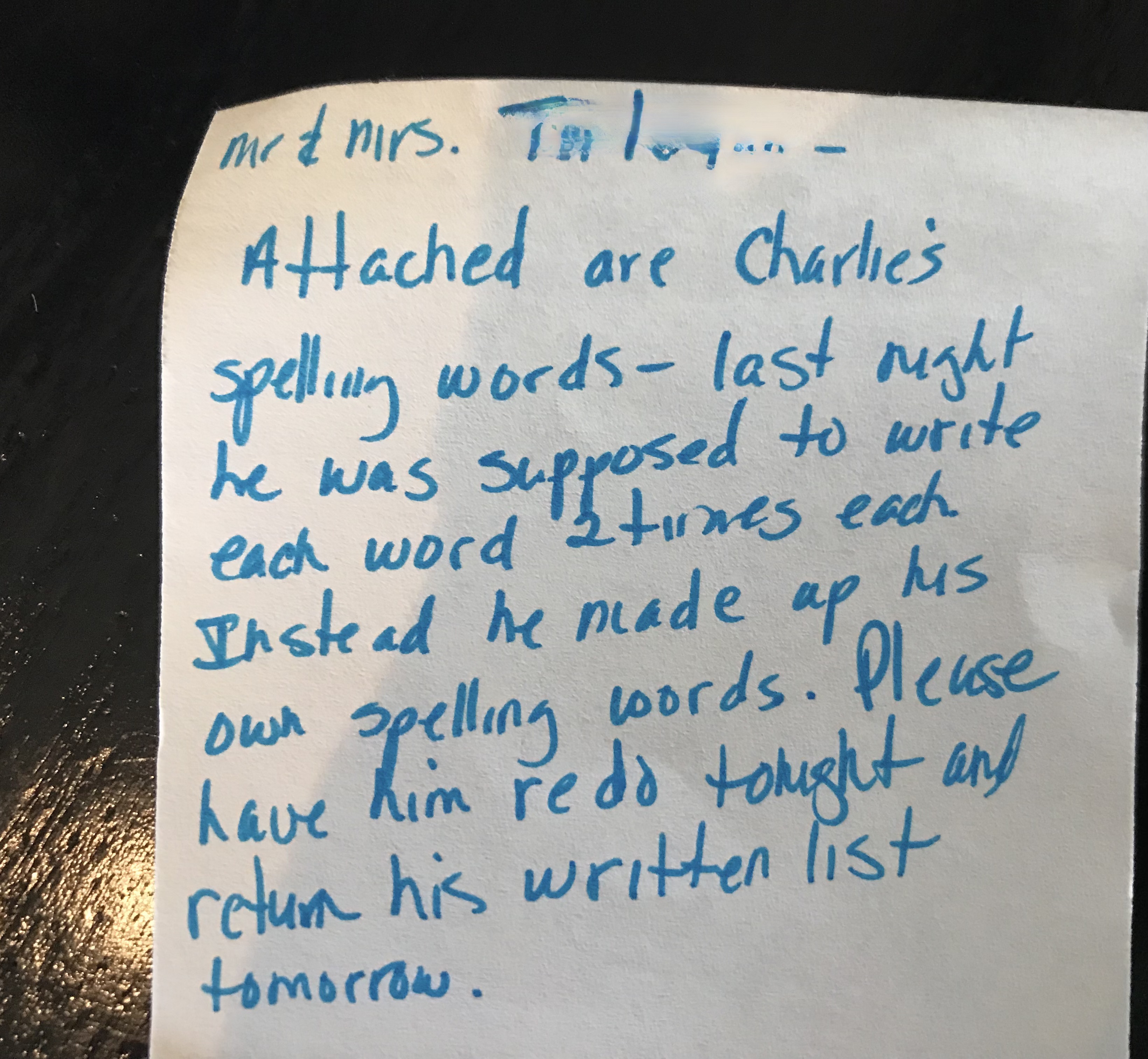
Sadly, our institutions of learning are often more rife with rules than with inspiring knowledge. The photograph below, (a teacher’s note found stuffed into the bottom of a Spiderman backpack along with a collection of old potato chips and small rocks) is an example of one student’s independent inventiveness in handling a homework assignment.

The world needs more Charlies. Those who ask why. Those who try it a different way. Perhaps, in the eyes of authority, it is not a better way, but how can you ever know if you are afraid to try? 

Schools have become brightly colored factories of fear rather than places of trust. Fear of bad grades, of tests, of not being smart enough, good enough, cool enough…not to mention the very real fear that many children suffer of being bullied. It is time to allow all students to grow in whatever rambling ways they will inside the halls of learning. Time to encourage the true seeds of knowledge – wonder, curiosity and the freedom to explore. Schools should not exist to clip wings, but to encourage flight. So, go ahead, make up your own words. And may they be wild and free enough to address an unknowable future.

Raising Children Who Care

©donnaesgro

Caring is an act of compassion. It is not simply an act of graciousness or generosity. It comes from deep inside the heart.

All children know the damage that a bully can inflict and they know the feeling of powerlessness when their friends turn and walk away, pretending not to see. How do we teach our children to turn towards, to see, and to act?

Showing your child how to be a caring, involved citizen, doesn’t mean that you have to lead a march or run for office. It is in the small everyday things that children learn. As parents and teachers we are the first role models. How do we treat others day to day? Do we show respect and concern for all beings? When we listen, share, and help, our children see who we are and imagine who they will be. They also see when we ignore, dismiss, or act selfishly.

Books, and the conversations they inspire, are great ways to instill compassion. When a child wants desperately for Dorothy to get back home and the evil witch to dissolve, the seeds of compassion and yearning for justice have been planted. Books can also take you to other places, teaching that there are many cultures and that each one is unique and special. Include books on the history of your own country, and of the world. These kinds of books will open your child’s mind and heart in ways that go far beyond what is literally on the page. 

The future is in our children’s small hands. And, as unknowable as it may be, one thing is certain, that the next generation will need courage and clarity of vision in a world that promises to be confusing and chaotic. They will need to know how to discern truth from lies and how to raise their voices against injustice of all kinds.

Long long ago a Native American chief was sitting by the fire with his grandson. “Tell me about the battles you have fought!” begged the little boy. His grandfather looked deep into the fire. “The most important battle I have fought is between the two wolves that are within us all.  One wolf is greedy, angry, arrogant, a liar and a hypocrite that thinks he is superior to all other wolves. The other wolf is gentle, full of hope, love, empathy, truth and kindness.” The boy became very quiet. He was listening for the two wolves inside him. “Which wolf is stronger?” he asked. “The one you feed,” replied his grandfather.

There is much in this world that needs heedfulness. The fate of our planet depends on it. Helping to solve these seemingly insurmountable problems will need critical thinking, of course, but equally as important, it will need hearts that truly care.

ADD For ALL

IMG_3215 2

copyright©donnaesgro

*

“She’s flighty.” “He’s a dreamer.”

Should these children be diagnosed, labeled and medicated to make them conform? Are they abnormal, or just marching to the beat of a different drummer? Perhaps she’s flying somewhere and he’s dreaming of something far more interesting than the worksheet of the day. Are we creating standardized children to excel on our standardized tests? Our culture values achievers. Does enduring the weariness night after night that many children feel at finishing their homework count as an accomplishment? How does a child who continually fails, who is labeled as a troublemaker, who never gets the shiny sticker awards, or the stellar grades, develop belief in himself?

When, in the United States, approximately six and a half million of all school age children, one in five of every high school boy, and over ten thousand toddlers are taking powerful medications after being diagnosed with ADHD, it’s time to change the system, not the children. How do we teach both the child and the teacher the difference between bouts of creative distraction, when one thought is allowed to pinwheel into a beautiful display of many thoughts, and distractions that are indications that the child is not connecting, for any number of reasons, to the subject being taught?

It is not likely that the educational system will soon change to accommodate different types of learners, but individual teachers can. It is a teacher who often is the one to bring up the possibility of ADHD to the unsuspecting parent at the first parent/teacher conference. Although the diagnosis is purely subjective, there being no definitive test, either psychological or physical, for this condition, parents assume that the teacher must be right. Of course there are teachers who may be right, who with much serious forethought have made the difficult decision to approach this sensitive issue. But, more often than not, the teacher is wrong and herself a victim of the aggressive pharmaceutical marketing campaigns that are truly shameful considering the grave side effects and the unknown impact on brain chemistry that can afflict a child taking Ritalin, Adderall, Concerta, or any of the other potent psychotropic drugs. In the last 20 years the number of narcotized children skyrocketed from approximately six hundred thousand to over 3.5 million.

Psychologist Dr. Keith Conners, Professor Emeritus at Duke University, who was one of the first researches to bring ADHD to the public’s attention as a neurobiological disorder, states in a 2013 NY Times article, “The numbers make it look like an epidemic. Well, it’s not. It’s preposterous. This is a concoction to justify the giving out of medication at unprecedented and unjustifiable levels.” In the same article Roger Griggs, the pharmaceutical executive and entrepreneur who coined the term “Adderall” after his Orwellian idea of combining “A.D.D.” and “for all”, calls these drugs, “nuclear bombs that should be prescribed only in extreme circumstances.”

Teachers, as first responders, must begin to see that celebrating diversity in the classroom means more than creating an environment that respects those of all cultures and colors.   It means creating an equal opportunity classroom in which differences of all kinds are not labeled as deficits. Mastery of a subject often requires perseverance and repetition, but must it appear to the child as boring and without purpose? Most children, even those with diagnoses of ADHD, are able to concentrate with surprising tenacity if a subject interests them. Watch a child build a tower over and over in order to get it to balance, or fathom out a complicated puzzle. What motivates a child to work at these high levels of concentration? This is the subject that we should be exploring, and that all teachers should be striving to understand. How can we spark curiosity and create stimulating lessons that inspire creative and attentive students? Has our society gone so far wrong as to believe that a child not sitting quietly over schoolwork is a deviant who must be drugged into submission? It is time to stop ostracizing the atypical and eradicate the illusion that our childrens’ learning problems can be alleviated with meds. Instead, let parents and teachers unite to do the hard work of examining our current educational system and find solutions that do not label our children as the problem.

Learning to Listen

IMG_8190

copyright©donnaesgro

*

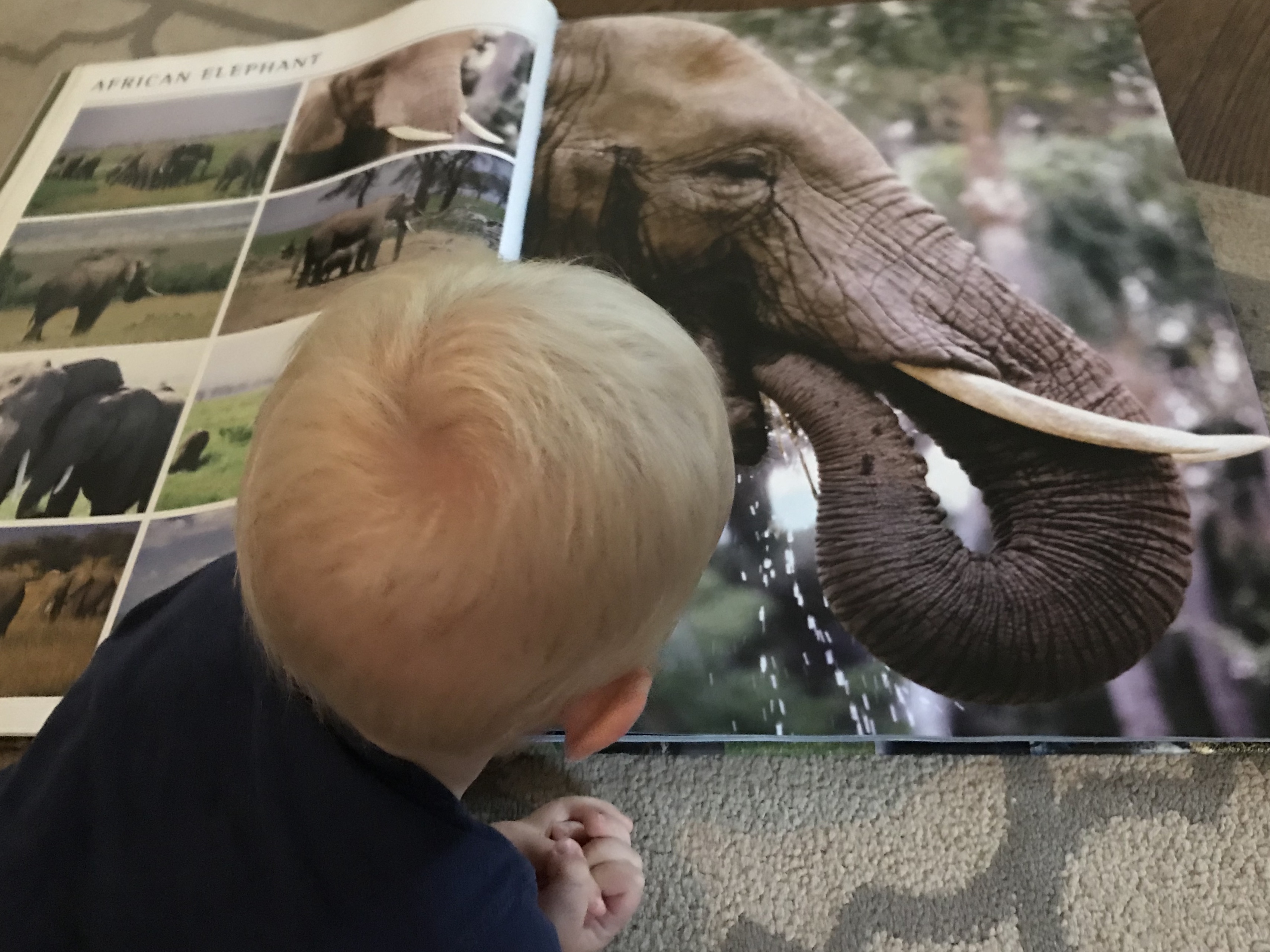
A child must learn to listen before he can listen to learn. Experts agree that the conditions which most affect  literacy take place in the home, long before a child enters school. Children listen, understand, and speak before they read, write, and spell. Without the former, the latter is impossible. It follows that the more developed a very young child’s language skills, the easier time he will have learning the academics of literacy. Reading to your child from the very beginning will help develop listening skills that are invaluable later in life. At first your active baby won’t have the attention span to allow you to read all the words of a book to her, but just sitting together enjoying books, talking about the illustrations, is enough to start. As time goes by, a young child who has access to a bookshelf will soon be seeking out books and sitting quietly pretending to read. This activity is not, simply, adorable. For a child, the act of pretending is a major step in learning a new skill.

In order to help a child learn to listen, keep the home environment as free of unnecessary distraction as possible. Turn off the background noise. This simple act will help to create a more peaceful atmosphere conducive to contemplation…and to reading. Music is not usually a distraction, but the news and commercials that accompany radio and television certainly are. Children are sensitive and their hearing is acute, try to shield them from the constant advertising and, more importantly, the disturbing violent events that are, sadly, so often in the news.

Another aspect in teaching children to learn to listen is to listen to them! The respect that you show when you pay careful attention to a child’s stories and questions teaches him the importance of listening. Ask interactive, open-ended questions that offer the child not only an opportunity to express himself but to develop cognitive skills. Avoid “baby talk” or talking down to a child. Children love “big” words; adults often underestimate their insatiable curiosity and innate ability to learn them. Books add a multitude of new words not used in daily life that enrich and enlarge your child’s vocabulary exponentially. The art of thoughtful listening is fast becoming obsolete. Help your child become attentive in a culture rife with sound bite  and the abbreviated language of texting. It is only in listening closely that we truly learn.

*

“The word ‘listen’ contains the same letters as the word ‘silent’.”  -Alfred Brendel, composer

The Power of Poetry

IMG_8030

copyright©donnaesgro

*

Poetry is often looked upon as irrelevant, a part of another era, when people had more leisure time, less distractions; when conversation was an art, and life wasn’t so frenetic. Yet, it is well documented by linguists that children who have early exposure to poetic verse and the phonemic and syllabic sensitivity it brings, have an easier time recognizing individual sounds and learning to read.

Poetry is the heartbeat of literature. Begin a rhyme in a room full of children and watch what happens…a sudden attentive stillness. Even babies, who can’t yet understand the meaning of the words, are entranced by the patterns, repetitions, and rhythms:

I am Sam

Sam I am

That Sam-I-am That Sam-I-am!

I do not like that Sam-I-am

Do you like 
green eggs and ham?

I do not like them, Sam-I-am.

I do not like 
green eggs and ham.

Dr. Seuss – Green Eggs and Ham

Rhyme draws attention to the ending sounds of individual words – alliteration to the beginning. The musical language of poetry rings and reverberates, creating in the child a fundamental joy in literature.

But should the reading of poetry end with nursery rhymes? The emotions that poetry evokes are universal. As children grow older, the reading and writing of poetry can help them to cope with vulnerable truths that are too fragile to share in other ways…love, pain, death, transcendence…feelings not likely to be discussed on social media.

Reading aloud one’s own poetry creates a forum for individual expression that inspires confidence and pride. To communicate profound feelings and see that others share them is a transporting experience. In a school system that stresses the head – test taking, memorization, grades, and competition – poetry celebrates the heart. In this increasingly homogenized culture, poetry’s power lies in its originality-whether wild with rage as in Allen Ginsberg’s Howl, or soft with the tenderness of e.e.cummings’ somewhere i have never travelled, gladly beyond, poetry connects us intimately and immediately to our deepest feelings.

The language of poetry encourages inventiveness with words. Hope is “the thing with feathers” (Emily Dickenson). Eyes are “the window to the soul”(Shakespeare). Poetry conjures images that broaden and enlighten the mind. Metaphor and simile invite the reader to look at life in different ways, using unexpected correlations that inspire creative thinking:

The fog comes

on little cat feet

It sits looking

over harbor and city

on silent haunches

and then moves on

Carl Sandburg – Fog

From the rocking rhythm of early lullabies to the healing strength of dirges, the simple truths of poetry cross all cultures, all boundaries. Introduce poetry early to share the wonder of words with your child, but don’t lose track of how poetry’s elegant, eloquent elucidation can inspire us throughout our life

Literacy – How it Begins

IMG_6165

copyright©donnaesgro

*

“The invariable mark of wisdom is to see the miraculous in the common.”

― Ralph Waldo Emerson

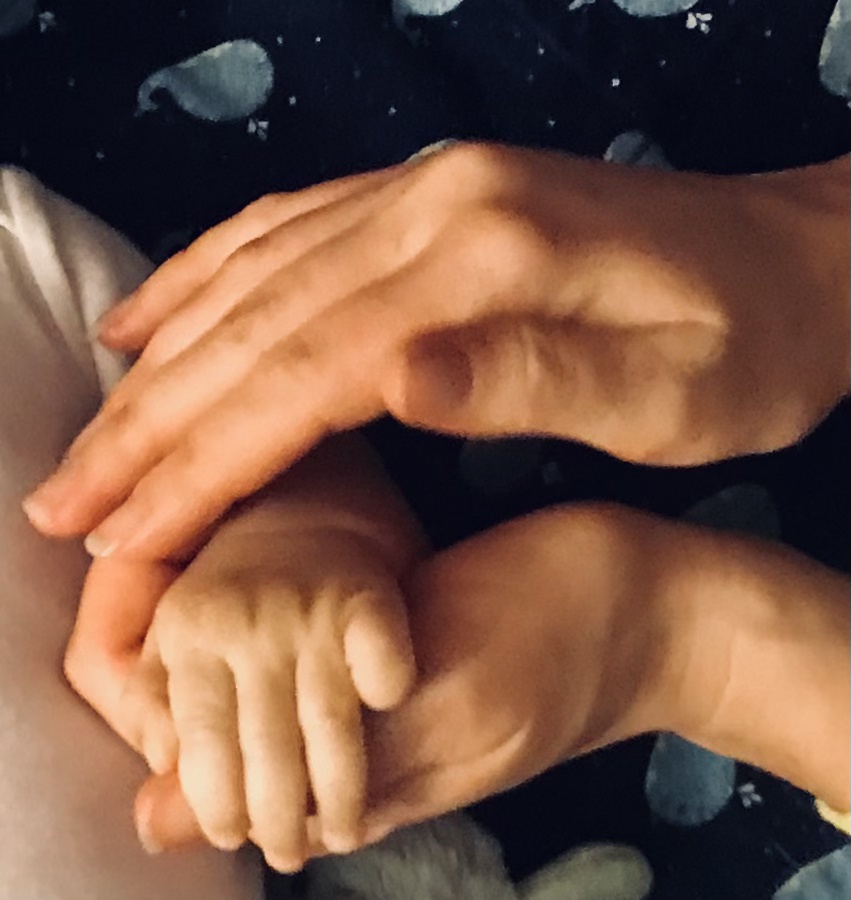
Oral language is the foundation of literacy. Within a few short months an infant’s cries become babbles, then, suddenly, talking! Soon, the young child understands the meaning of thousands of words. The acquisition of language happens at a remarkable speed. Every time a child learns something new, it becomes a part of his knowledge base. Since words are simply articulations of concepts and feelings, it is evident that a child’s vocabulary should be measured not by how many words he knows, but by what he knows about each word.

The more ideas that the child is exposed to, the deeper her understanding of certain terms: A child whose favorite book is Goodnight Moon understands the conception of the moon in a more visceral way once she has seen a bright full moonrise, or watched the moon disappear behind a cloud lined with silver. Thereafter, whenever the book is read to her, these images flood her mind allowing a richer appreciation of both the word moon and the familiar bedtime story.

One of the most giving words in the English language is the word, “Look!” When you invite a child to look, you give him the gift of your time, attention, and awareness. You joyfully invite him to join in a shared experience and with this simple word illustrate how communication bonds us. “Look! A dragonfly!” Fills the child’s mind with dragons, butterflies, fairies… “Can it breathe fire?” I have been asked. These opportunities to enlarge your child’s perspective happen daily, and books are a wonderful way to extend this rapid accumulation of knowledge. While the opportunity to see a rainbow doesn’t happen everyday, books, both fiction and non-fiction, can share the beautiful imagery of a rainbow with your child, reinforcing such basics as color recognition, but more importantly, encouraging him to see the wonder and glory of the natural world…and to look for rainbows everywhere.

Children are born scientists – curious and eager to explore. Knowledge is not a mere collection of facts, it is alive, pulsing-a process of discovery. Books provide an access to worlds that we cannot, otherwise, enter. From the bioluminescent depths of the sea to the mystical outer edges of the known universe, books satisfy the need and the love for communication that begins with the infant’s first cries.