Category Archives: Uncategorized

A Few Thoughts On Annotation

IMG_3214

copyright©donnaesgro

*

“In his blue gardens, men and girls went like moths among the whisperings and the champagne, and the stars.”

F. Scott Fitzgerald, The Great Gatsby

***

Imagine a roomful of high school Sophomores, their paperback Great Gatsby novels decorated with a rainbow of day glow highlighters.

They are preparing for this quiz:

In 3 -5 Sentences:

1. Describe Gatsby

2. Describe Daisy

3. Describe Gatsby and Daisy’s relationship

The tumultuous relationship between Gatsby and Daisy is a many layered, psychologically and socially complex one.

“No amount of fire or freshness can challenge what a man will store up in his ghostly heart.” F. Scott Fitzgerald, The Great Gatsby

The meaning behind the two protagonist’s relationship is a question that even experts in the field of modern American literature continue to ponder. And what does “Describe Gatsby” “Describe Daisy” mean? Physically? Emotionally? Intellectually? All in 3-5 sentences? These kinds of questions, for which annotation is supposed to help one prepare, cheapen the extraordinary beauty and depth that F. Scott Fitzgerald so elegantly crafted into The Great Gatsby – the quintessential 20th Century novel that most literary scholars believe is his best.

When reading classic literature, there is a bond that forms between writer and reader. The bond flows back and forth page after page as the reader becomes more immersed in the story. There is certainly no book without an author, but there is also no book without a reader. Without a reader a book is like the sound of a tree falling alone in the forest, or the sound of one hand clapping. The writer and reader fall deeply into a metaphysical conversation, a meeting of minds. Annotating – pausing, highlighting, writing question marks in the margins, etc., disrupts this. Imagine being in a deep, meaningful conversation with someone and interrupting every few minutes to write down pertinent points.

Classic literature enchants. We are meant to fall into the dream of the writer. If the reader doesn’t note all the metaphors, similes, and symbols, don’t worry, leave her free to fall in love with the author’s voice and she will go back to the story again and again-each time learning something new. We bring ourselves and all our assorted opinions, neurosis, and desires to the reading experience. An English teacher’s view of life is going to be very different than a fifteen year old’s. Let the children read in peace. What is the point of analyzing the character’s every move? Students will feel the character’s emotions, and isn’t that far better? And, what does it matter if one doesn’t perform well on a multiple-choice quiz? Has there ever been a multiple-choice quiz that enriches a literary experience?

English teachers ask their classes to annotate key points throughout an assigned book. How are the students to know what is key to the plot in the first few chapters? Let the book reveal its mysteries in its own time-as the author wished.The only reason to annotate a text is to prepare for an exam. The highlighter’s purpose is to lead the student to key characters and events that could pop up in a pop quiz. Sometimes a story is not unlocked until the very end. The author will hand you the key when he or she is ready. Tests are not for the students, they are for the teachers, to prove in black and white that they are teaching something-that their pupils are learning. That is why, so often, teachers “teach to the test” – a practice that is anti-learning, particularly in subjects that are open to interpretation, like literature. Tests on literature are “inside the box” tools, pre-thought out conclusions that demand a “correct” answer, although, often, there is none. How I understood Daisy in High School, and how I understand her now are quite different. Who is to say which interpretation is better? richer? more what the author intended? How can these kinds of responses, which are what reading is all about, be tested and graded for accuracy?

Throw away the highlighters, the flash cards, and the spark notes. Find some dappled shade and just read. Read for fun, read for enlightenment, read for joy, read for pleasure, read to journey to other lands and other centuries, read to learn-about yourself and all the wonders of the world, but don’t read to pass an exam.

“I didn’t know what to say. I felt like crying, Goddammit everybody in the world wants an explanation for your acts and for your very being.”  Jack Kerouac, On the Road
In Praise of Battered Books

IMG_8704

copyright©donnaesgro

*

“Do you know that books smell like nutmeg or some spice from a foreign land? I loved to smell them when I was a boy. Lord, there were a lot of lovely books once, before we let them go.”

Ray Bradbury – Fahrenheit 451

*

I remember my mother sitting on a blue wooden bus bench in Santa Monica, California, absorbed in a paperback detective novel. She was a displaced New Yorker, familiar with the ennui of bus, train, and subway stations.

As soon as I was old enough to read, she advised me, “Always carry a paperback book with you-that way you will never mind waiting.”

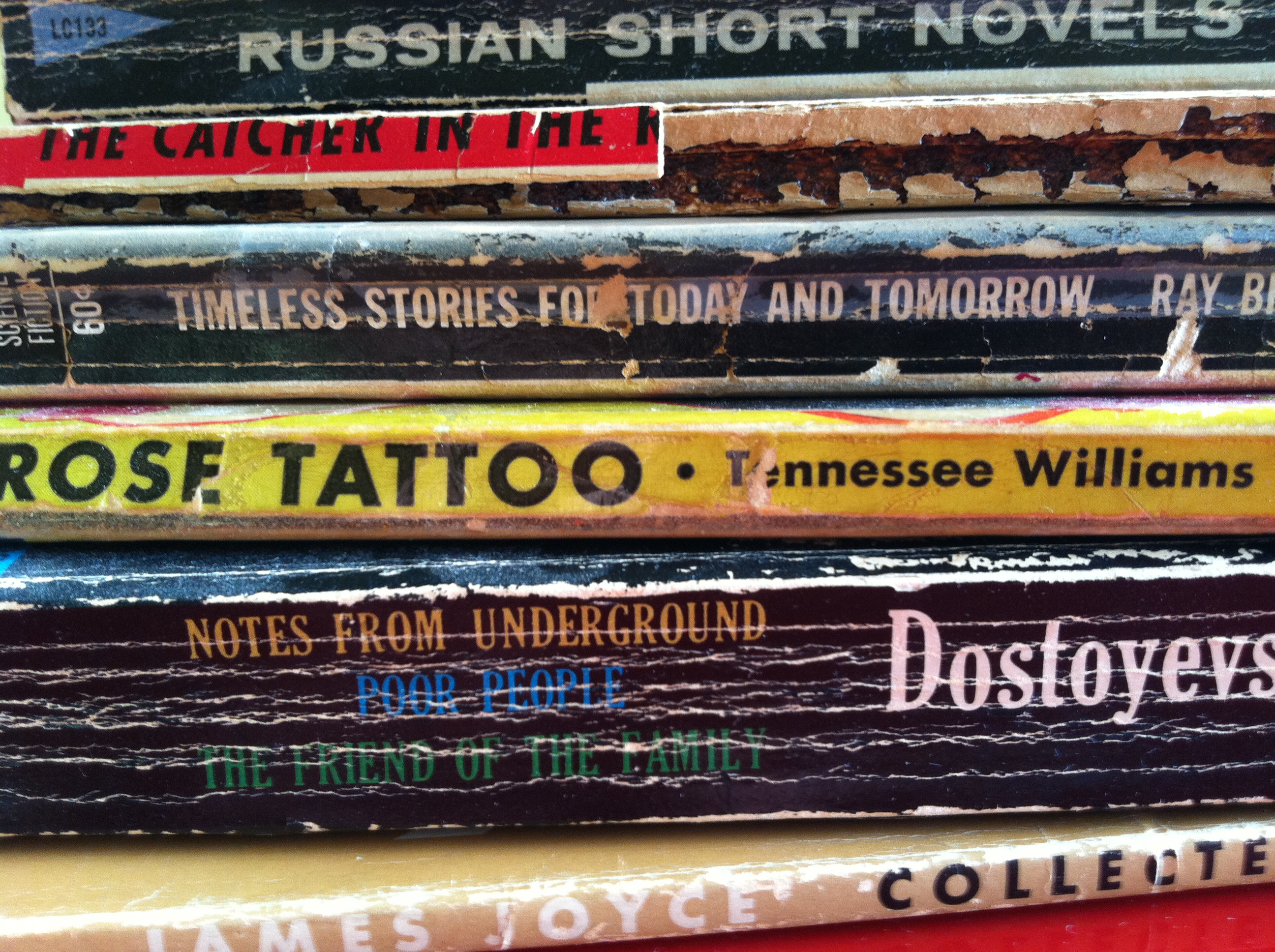
And that’s how it began – my collection of battered books. Library books stayed at home, but there was absolute freedom in a paperback, sand in-between the pages, blowing in the wind. It all began with a little girl in blue glitter glasses reading Nancy Drew on the school bus and The Secret Garden in the back seat of the car.  Then, my best friend in middle school introduced me to the dark, lovely, literary, wildness of Ray Bradbury. I’d spend the night at her house, the two of us reading Something Wicked This Way Comes, from one paperback book, under the covers, eating M & M’s, long into the night.

As a restless young teenager, I walked the tree lined streets of my neighborhood with Walden’s Pond in the back pocket of my jeans. Sitting under the fragrant Eucalyptus trees, I’d pretend I was alone in the woods.

And then there was the lanky intense boy, one impossible year older, who read Dostoyevsky aloud to me on my front porch steps until the houses around us turned into sharp silhouette and the porch lights blinked on. Our sweet sixteen love lasted one jasmine soaked summer, but he left me Fyodor, and a paper back The Brothers Karamazov whose cover has been taped back on a dozen times.

I was accompanied by Salinger, Ferlinghetti, and Hermann Hesse on my first plane trip to San Francisco. I was seventeen and free – drinking out of tiny cups at the Japanese Tea Garden in Golden Gate Park with my book propped on the table.

I have an old Art Deco style glass case protecting the first editions in my home. When I open the intricately carved doors the musty smell of old paper wafts and mesmerizes. But in my handbag, I have a revolving assortment of paperbacks, content to be jostled about, ignored for days, then read non-stop for hours-like old friends who can be silent together until it’s time to talk deeply.

I have a great reverence for books, and turn the pages carefully in my old and valuable ones, but paper back books get thrown into back packs, go with you on hikes, on camping trips, or barefoot to the beach on a sweltering summer day. They can be left out in the dew all night, and not lose their beauty.

Read them, share them, and when you are ready, leave them one by one  on scattered benches in memory of my mother.

Why Should You Read the Book Before You See the Movie?

IMG_1715

copyright©donnaesgro

*

Hans Christian Andersen’s Little Mermaid quests for an Immortal Soul

Disney’s mermaid, Ariel, quests for a Prince Charming.

My fourth grade Book Club recently finished reading James and the Giant Peach. Each meeting was spent reading a chapter or two out loud, taking turns being different characters, and talking about what the words made us think or feel. Raoul Dahl’s descriptive language made is easy to imagine both the scenes and the characters: “For suddenly, just behind him, James heard a rustling of leaves, and he turned around and saw an old man in a crazy dark-green suit emerging from the bushes. He was a very small old man, but he had a huge bald head and a face that was covered all over with bristly black whiskers.”

I was reading from an edition with the original illustrations by Nancy Ekholm Burkert, while the children’s books were more recent editions, illustrated by Quentin Blake. We used this difference to contrast and compare the illustrator’s interpretation of the story. Everyone noticed that my book’s drawings were eerie and mysterious, while theirs were humorous. This led to a discussion about Dahl’s style, how, indeed, his stories were both strangely frightening and oddly funny.

Each one of us imagines a different world when reading James and the Giant Peach, each envisions a different old man. But what if one sees the movie before reading the book? Whose vision would he see? Viewing a movie first limits the ability to imagine own’s one scenes and characters. It stifles the individual’s ability to conjure an alternate reality-one of the truly enchanting aspects of reading. “As with all great art, the fairy tale’s deepest meaning will be different for each person, and different for the same person at various moments in his life. The child will extract different meaning from the same fairy tale, depending on his interests and needs of the moment.” Bruno Bettelheim – The Uses of Enchantment

In the 1996 film adaptation of James and the Giant Peach, Aunt Spiker looks like Joanna Lumley, and Miss Spider is a heavily made up French vamp in a beret and high black leather boots. Not that these portrayals aren’t brilliant, but they are not one’s own. Our imaginations are limitless. Imagination, like dreaming, is a uniquely personal experience; movies, a group one. There is also a very good chance that once a child (or an adult) sees the movie version of a book she will lose interest in reading it. This is especially true of children who are struggling with reading, or teenagers who live in such a fast paced electronic whirlwind that they lose patience with the time it takes to read a novel, particularly a classic novel with somewhat arcane language. If the only experience one has with a particular book is through the movie version, he is missing out on a deeper, richer interpretation of the story. When a child reads a book before seeing a movie he understands the source of the story, makes the connection between written words and the images in the movie. The movie is not seen as an isolated experience. Having read the book allows the child to understand the movie in greater depth. There are many great authors (Pamela Travers, author of the Mary Poppins Series) who have been extremely disappointed with how their works were translated to film. Others, such as Raoul Dahl and Theodore Geisel had works sold posthumously to movie producers because the authors just didn’t believe that the experience that they wanted the reader to have could be translated well into film. Neither Victor Hugo (The Hunchback of Notre Dame), A.A.Milne (Winnie the Pooh), nor Lewis Carroll (Alice in Wonderland) lived long enough to comment on the animated version of their classic works. So we can only wonder…

Letter, written in 1957 from J.D. Salinger regarding movie rights to Catcher in the Rye:

blogSpan

I love good films and would want every child to see the classic 1939 production of The Wonderful Wizard of Oz. But read the book first. Let your child step into Dorothy’s slippers and walk the yellow brick road herself before the charming Judy Garland and the rest of her immensely talented companions, Bert Lahr, Jack Haley, and Ray Bolger, completely capture her imagination. When a child first reads The Wonderful Wizard of Oz, she will discover that L.Frank Baum wrote a series of Oz books – all quite magical and wild, and rarely read by children today. One good book leads to others.

With very young children there may be other reasons to read the book first and wait until they are older before they see the movie. Child experts have noted that separation anxiety is frequently used as an emotional hook in Disney films. And, although children’s imaginings, when reading or being read to, are profound, they do not normally traumatize as many a villain in Disney movies have.

Charming as Disney characters can be, it is important not to lose site of the fact that Disney is a multi-billion dollar industry, thanks to your children. Although there have been recent attempts to break the traditional Princess roles, generally female characters in Disney films give young girls an unrealistic, highly commercialized standard of beauty that reinforces extreme and one dimensional gender role stereotypes. When reading the original fairy tales, there is much more emphasis on the idea that beauty is used as a metaphor for goodness, and not for selling back- packs. There is no question that movies, even those made specifically for children, have become more violent, and more realistic in that violence. This, paired with the easy access to movies in the modern home through internet streaming, cable, etc., is cause for concern. Children today watch far more movies than previous generations. The fast paced editing, garish coloring, casual violence, and loud sound tracks stimulate children who often internalize the conflicting emotions that arise – feelings which, with many children, can cause restlessness, anxiety, and aggressive behavior. Books calm children down, develop their cognitive abilities, and help them feel in control of their emotions. Rather than desensitizing them to violence, books help develop empathy and compassion for others. Often, young children are media illiterate and believe that what they see in the movies is true. They are better able to understand the role that “pretend” plays when reading a book.

In my experience teaching, I am surprised to see how many children don’t realize that their favorite movies began with books, and that some of these stories are over 100 years old – that someone had to first imagine a story and then write it down before a movie could be made. Understanding such simple facts broadens historical perspectives and helps comprehension. I don’t want my young students to think that they know the story of Beauty and the Beast, The Little Mermaid, Winnie the Pooh, or Alice in Wonderland based on the popular animated versions. I want them to be explorers in the world of literature. I want them to realize the art, truth, and beauty of these original stories.

The key to captivating children on the sultry beauty of language is to start early. Make it a family rule that your child reads the book before he sees the movie. If he is too young to read, read to him. I am a great believer in parents continuing to read stories to children long after they can manage the reading themselves. It is a delightful shared practice that tells your child how much you value literature, and how important it is for you to share that appreciation with him. If you pick the right books, especially those that you loved as a child, you will not regret it. It is a wondrous thing to read great stories aloud.

Finally, reading, because it is active rather than passive, helps to develop logic and cognitive skills. It improves concentration, comprehension, vocabulary, and writing skills. Or, put in a more succinct way:

“If you want your children to be intelligent, read them fairy tales. If you want them to be more intelligent, read them more fairy tales.” Albert Einstein

Play Makes You Smart

article-2331639-1A066DEC000005DC-390_964x847

copyright©Bettmann/CORBIS

*

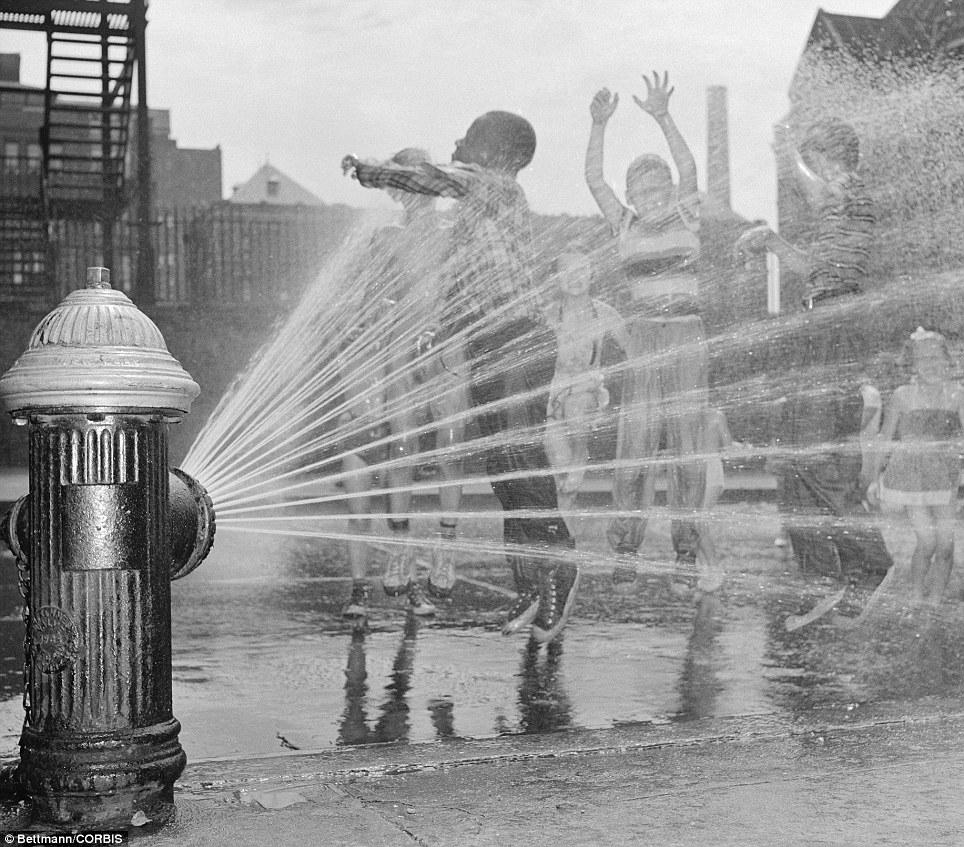
Play is vital in the acquisition of early literacy skills. At first babies play alone or with their immediate care giver, then side by side with peers (parallel play). At about the age of two and a half children begin to engage in imaginative play-they pretend, and when they pretend, they tell stories. Stories with plots, action, characters – liner stories with sequence. These stories present the child with a delicate balance of challenges both physically and mentally. In play, as in reading, children grapple with abstract ideas and differing points of view that allow a multitude of opportunities to learn.

The dragon climbs to the top of the highest mountain (the slide) and roars! We all run and the dragon chases us. He’s breathing fire! Where will we hide? In the castle (the tent), the dragon can’t get us there!

In play, children use multiple intelligences: visual, auditory, tactile, and kinesthetic, to experience the joy of storytelling. Play is so important in healthy child development that the United Nations High Commission for Human Rights has called it “The right of every child”.  Many children live tightly scheduled lives with very little time for child driven play, and when they do have free time, they often gravitate to passive entertainment such as television or computer/video games. In an effort to raise test scores, more and more schools have cut recess time to concentrate more on academics and formal physical education. Ironically, child development experts have found that reduced time for unstructured play may be a cause for restless anxiety in children that results in falling behind academically. In addition, neuroscientists now know that there are indisputable links between learning and physical activity- in order to be able to process new information the brain needs a balance of activity.  Think: All work and no play makes Jack a dull boy.

Play drives development. It is the hands on mechanism that children use to learn. In spontaneous play the child expresses what he is currently processing emotionally, intellectually, and physically. When choosing toys, look for interactive items that encourage creativity, such as blocks or dolls instead of passive toys that limit imagination. Advertisers are adept at creating a “cool factor” that encourages acquisition and competition around toys often linked to popular movies. Toys designed to be discarded when the next trend comes around. Free play with timeless toys such as chalk, bubbles, balls, and water itself, is refreshingly outside this foray of manipulative mass marketing and, because these types of toys require hands on exploration, help develop the cognitively flexible skills necessary for readiness to read.

In the attached Ted Talk, Dr. Stuart Brown, a pioneer in research on play and President of The National Institute For Play, speaks of the deep need for play, not only in humans, but in all species:

http://www.ted.com/talks/stuart_brown_says_play_is_more_than_fun_it_s_vital?language=en

In honoring the child’s freedom to play, we honor the “whole” child. It is impossible to know what challenges our children will face and what skills will be required of them in the future. But, emotional intelligence, tenacity, the ability to actively engage with others, to focus with keen attention, and to approach problems with creative solutions-skills honed in the playground- have always and will always be critically important.

ADD For ALL

IMG_3215 2

copyright©donnaesgro

*

“She’s flighty.” “He’s a dreamer.”

Should these children be diagnosed, labeled and medicated to make them conform? Are they abnormal, or just marching to the beat of a different drummer? Perhaps she’s flying somewhere and he’s dreaming of something far more interesting than the worksheet of the day. Are we creating standardized children to excel on our standardized tests? Our culture values achievers. Does enduring the weariness night after night that many children feel at finishing their homework count as an accomplishment? How does a child who continually fails, who is labeled as a troublemaker, who never gets the shiny sticker awards, or the stellar grades, develop belief in himself?

When, in the United States, approximately six and a half million of all school age children, one in five of every high school boy, and over ten thousand toddlers are taking powerful medications after being diagnosed with ADHD, it’s time to change the system, not the children. How do we teach both the child and the teacher the difference between bouts of creative distraction, when one thought is allowed to pinwheel into a beautiful display of many thoughts, and distractions that are indications that the child is not connecting, for any number of reasons, to the subject being taught?

It is not likely that the educational system will soon change to accommodate different types of learners, but individual teachers can. It is a teacher who often is the one to bring up the possibility of ADHD to the unsuspecting parent at the first parent/teacher conference. Although the diagnosis is purely subjective, there being no definitive test, either psychological or physical, for this condition, parents assume that the teacher must be right. Of course there are teachers who may be right, who with much serious forethought have made the difficult decision to approach this sensitive issue. But, more often than not, the teacher is wrong and herself a victim of the aggressive pharmaceutical marketing campaigns that are truly shameful considering the grave side effects and the unknown impact on brain chemistry that can afflict a child taking Ritalin, Adderall, Concerta, or any of the other potent psychotropic drugs. In the last 20 years the number of narcotized children skyrocketed from approximately six hundred thousand to over 3.5 million.

Psychologist Dr. Keith Conners, Professor Emeritus at Duke University, who was one of the first researches to bring ADHD to the public’s attention as a neurobiological disorder, states in a 2013 NY Times article, “The numbers make it look like an epidemic. Well, it’s not. It’s preposterous. This is a concoction to justify the giving out of medication at unprecedented and unjustifiable levels.” In the same article Roger Griggs, the pharmaceutical executive and entrepreneur who coined the term “Adderall” after his Orwellian idea of combining “A.D.D.” and “for all”, calls these drugs, “nuclear bombs that should be prescribed only in extreme circumstances.”

Teachers, as first responders, must begin to see that celebrating diversity in the classroom means more than creating an environment that respects those of all cultures and colors.   It means creating an equal opportunity classroom in which differences of all kinds are not labeled as deficits. Mastery of a subject often requires perseverance and repetition, but must it appear to the child as boring and without purpose? Most children, even those with diagnoses of ADHD, are able to concentrate with surprising tenacity if a subject interests them. Watch a child build a tower over and over in order to get it to balance, or fathom out a complicated puzzle. What motivates a child to work at these high levels of concentration? This is the subject that we should be exploring, and that all teachers should be striving to understand. How can we spark curiosity and create stimulating lessons that inspire creative and attentive students? Has our society gone so far wrong as to believe that a child not sitting quietly over schoolwork is a deviant who must be drugged into submission? It is time to stop ostracizing the atypical and eradicate the illusion that our childrens’ learning problems can be alleviated with meds. Instead, let parents and teachers unite to do the hard work of examining our current educational system and find solutions that do not label our children as the problem.